You do not need to be fearless to start scuba certification. You need to be teachable, reasonably comfortable in the water, and willing to learn one skill at a time with an instructor who keeps the pace calm and clear.
That matters more than most first-time divers realize. A good course is not about rushing through a checklist so you can say you are certified. It is about building real comfort underwater – because comfort is what lets you enjoy the reef, stay aware of your buddy, and make smart decisions when conditions are less than perfect.
What scuba certification actually gives you
At the entry level, scuba certification teaches you how to dive safely with a buddy within the limits of your training. You learn how your equipment works, how pressure affects your body, how to communicate underwater, and how to handle common situations without panic.
For most travelers, the first full certification is Open Water. Once completed, it allows you to join dives around the world, rent gear in many destinations, and continue into advanced training. More importantly, it gives you a foundation. Without that foundation, diving can feel like guessing. With it, the experience becomes much more relaxed and rewarding.
This is also where people start to see the difference between a discount course and a quality one. The certification card may look similar in the end, but the training experience can be very different. Small groups, patient coaching, and well-maintained equipment do not just feel better – they usually produce more confident divers.
Who should get scuba certification
If you have been curious about diving for a while, certification makes sense when you want more than a one-time introduction. A resort try-dive can show you what breathing underwater feels like. Full training is for people who want the freedom to keep diving on future trips.
You do not need to be an athlete. You do need basic health, comfort in the water, and the ability to follow instructions. Some students are strong swimmers who adapt quickly. Others are more cautious and need extra repetition with mask skills or buoyancy. Both can do very well when the instruction is hands-on and the pace is right.
It also depends on your goals. If you only want to test the experience once, an intro program may be enough for now. If you already know you want to see more of the underwater world – reefs, turtles, rays, and deeper sites over time – getting certified is the smarter next step.
How scuba certification works
Most entry-level programs have three parts: academic learning, confined-water skill practice, and open-water dives.
Classroom or digital learning
This part covers dive theory. You learn the basic physics and physiology behind scuba, safety rules, dive planning, and equipment use. Done well, this section is practical, not overly technical. The goal is to help you understand why you are doing things, not just memorize answers.
Many divers now complete this portion online before arriving. That can be a great option for a vacation schedule because it leaves more trip time for actual in-water training. Still, self-paced learning requires discipline. If you rush through the theory, it will usually show up later when you are trying to solve simple problems underwater.
Confined-water training
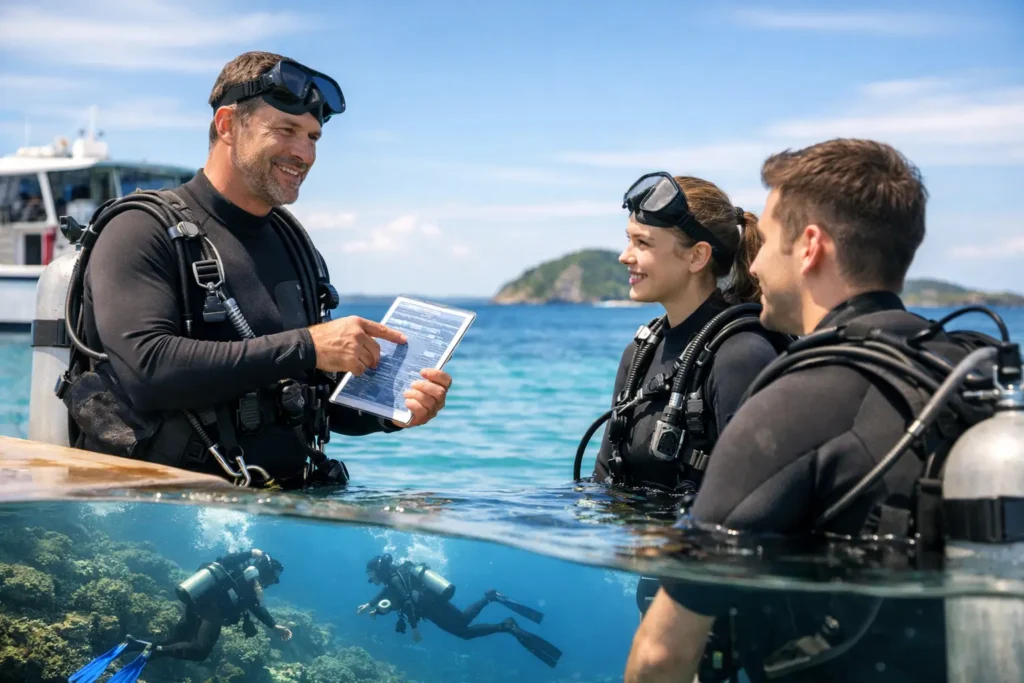
This is where trust gets built. In a pool or calm shallow water, you practice the core skills that make diving safe and manageable. You learn how to clear water from your mask, recover a regulator, control your buoyancy, and respond to common issues in a calm way.
For beginners, this is often the most important part of the course. Not because it is the hardest, but because it shapes your confidence. Students who feel supported here usually carry that confidence into open water. Students who feel rushed often end up certified but still uneasy.
Open-water dives
These dives bring everything together in real conditions. You repeat key skills, manage your buoyancy, descend and ascend with control, and begin to function as a diver rather than a passenger.
This stage should feel like progress, not pressure. Conditions matter a lot. Calm seas and clear briefings help new divers focus on learning. Challenging current, poor visibility, or oversized groups can make the same certification much more stressful than it needs to be.
How long it takes
Scuba certification is not one-size-fits-all. Many Open Water courses are completed over a few days, especially if the academic work is finished in advance. That schedule works well for travelers, but there is a trade-off. A shorter timeline is convenient, yet some students benefit from a bit more breathing room between sessions.
If you are a quick learner and already comfortable in the water, a compact course may feel efficient and smooth. If masks make you nervous or equalizing takes practice, a more personalized schedule can make the experience much better. The right operator will tell you that upfront instead of forcing everyone into the same pace.
Choosing the right place for scuba certification
Where you train has a real effect on how your certification feels. Warm water, manageable conditions, and attentive instructors can make the learning curve much less steep.
Costa Rica is a strong option for travelers who want training paired with marine life and a memorable trip. But the destination alone is not enough. What matters is how the operation runs day to day. Ask about group size, equipment maintenance, instructor involvement, and whether the team can adapt to different comfort levels.
That is especially important if you are learning while traveling with a partner or family member who may not be on the same path. One person may want full certification while another prefers snorkeling or guided fun dives later in the trip. A well-run dive center can help everyone fit into the same vacation without making the experience feel fragmented.
What makes a student feel confident underwater
Confidence is not the same as bravado. The best new divers are usually the ones who stay calm, ask questions, and practice carefully.
A good instructor helps by keeping explanations simple and corrections specific. Instead of saying, “Relax,” they show you how to slow your breathing, adjust your trim, or fix a small issue before it becomes a bigger one. That kind of coaching matters. It turns abstract advice into something you can actually use underwater.
Equipment quality matters too. When gear is clean, properly fitted, and maintained with care, students have one less thing to worry about. Small details like a mask that seals well or a regulator that breathes smoothly can change the entire tone of a first course.
Common concerns before starting scuba certification
The biggest worry is usually, “What if I panic?” That fear is common, and it does not disqualify you from diving. Training is designed to reduce uncertainty by giving you clear steps and repetition. Panic is less likely when you understand what is happening and know what to do next.
Another concern is swimming ability. You do not need to be a competitive swimmer, but you should be capable and comfortable in the water. There are also medical considerations, especially involving ears, lungs, or certain chronic conditions. Any responsible operator will have you review a medical questionnaire before training begins.
Some travelers also wonder if certification will take over their whole trip. It can, but it does not have to. If your schedule is planned well, training can fit into a broader vacation with time for rest, sightseeing, and other ocean activities.
After your certification, what comes next
The smartest next step is not always a deeper course right away. For many new divers, the best move is simply to keep diving while the skills are fresh. A few guided fun dives after certification can do more for your buoyancy and awareness than jumping too quickly into the next card.
That said, advanced training becomes valuable once you start seeing where you want to grow. Maybe you want better navigation, more confidence in varying conditions, or experience at greater depths. Maybe you want to move toward rescue training or eventually into Divemaster. Good progression feels earned, not rushed.
For travelers coming to Guanacaste, that can mean learning in a setting where the training and the reward are close together – one day practicing core skills, the next spotting turtles, rays, or reef life with a new level of control and awareness. At ChrisDiving, that balance of safety, small-group coaching, and real in-water confidence is what makes training worth doing in the first place.
Scuba certification is not about proving you are brave. It is about becoming capable enough that the ocean feels less intimidating and far more open. When your training is done right, you do not leave with just a card – you leave ready for the next descent.


