
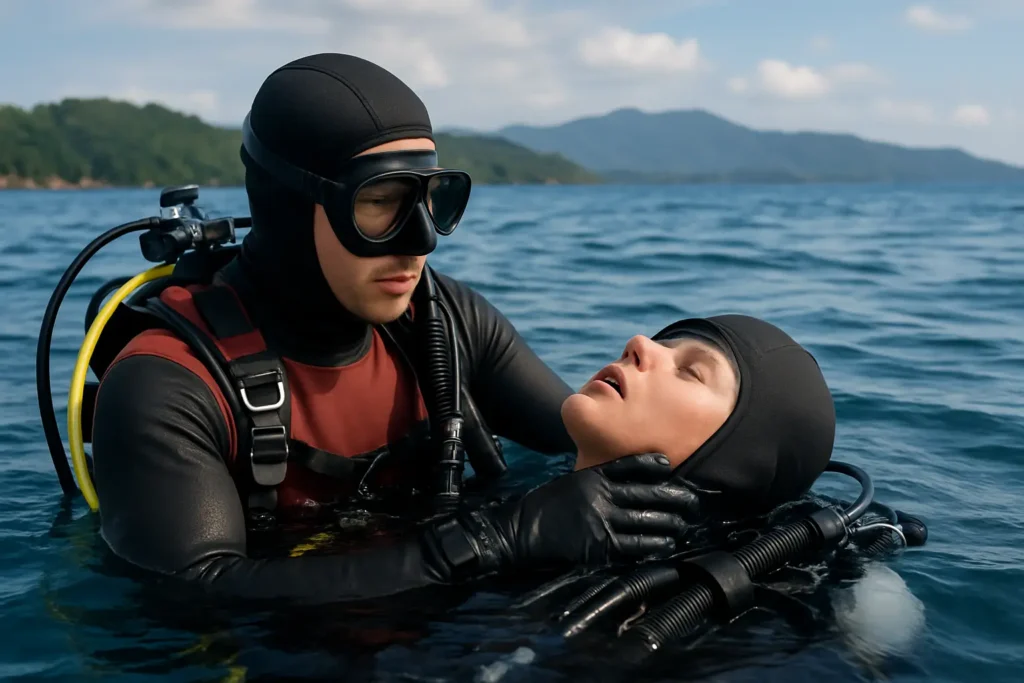
You don’t sign up for a Rescue Diver course because you want more plastic in your wallet. You sign up because you’ve had that moment underwater – the one where you realize confidence is not the same thing as competence. Maybe you saw a diver fighting their buoyancy near the surface. Maybe your buddy’s air dropped faster than expected. Or maybe you simply want to feel like the person who can calmly handle problems instead of hoping they don’t happen.
A rescue diver course in Costa Rica is a great fit for that goal because the diving here keeps you honest. The Pacific can be warm and clear, but it can also bring surge, current, and changing conditions around islands and points. That mix is exactly what makes rescue training feel real – and why graduates often say it’s the most valuable course they’ve taken.
What a rescue diver course actually changes
Rescue training is not about turning you into an underwater superhero. It’s about building a repeatable way to think. You learn how to notice small issues before they become big ones, how to manage stress (yours and someone else’s), and how to lead when everyone else is looking for direction.
The biggest shift is that you stop diving only for yourself. You start scanning the full scene: entries and exits, surface conditions, diver behavior, equipment setup, and whether a plan still makes sense when conditions change. That awareness carries into every fun dive you do afterward.
Why Costa Rica is a smart place to do it
Costa Rica is known for big marine life, but the more important reason to train here is environmental variety. Local sites can include boat diving, offshore islands, and situations where the surface can be active even when the underwater portion is calm. That creates natural opportunities to practice realistic surface management, buddy support, and controlled responses.
It also means the course is not one-size-fits-all. Some days are ideal for practicing search patterns and controlled lifts. Other days are better for shore-based skills, surface approaches, and problem-solving with waves and wind in mind. A good instructor will use those variables to build judgment, not just check boxes.
Prerequisites and who it’s for (and who should wait)
Most divers take Rescue after earning Advanced-level training or a handful of additional dives beyond Open Water. You don’t need to be a technical diver. You do need to be comfortable enough that basic skills are not taking all your attention.
Expect to need current first aid and CPR training (often packaged as “React Right” or similar). If you’re traveling, it’s worth planning this part early because it affects scheduling. If you haven’t been diving recently, doing a short refresher first is not a step backward – it’s a smart way to make the rescue course more enjoyable and less stressful.
You might want to wait if you still feel anxious simply being underwater, or if buoyancy and mask clearing regularly spike your stress. Rescue training can still be for you, but it will be far more effective after you’ve built comfort and control. It depends on what’s driving your hesitation: normal nerves are fine; persistent panic signals you should build foundations first.
What you’ll practice in a rescue diver course Costa Rica
A rescue diver course is scenario-driven. You’ll practice skills, but the point is how you apply them under pressure. Training usually starts with self-rescue and prevention habits: how to avoid becoming part of the problem.
Then you move into helping others. You’ll work on recognizing stress, approaching a diver safely, and making quick decisions about what to do next. This includes surface responses – because many emergencies escalate at the surface, not at depth.
You’ll also practice bringing a diver to safety, towing efficiently, and exiting the water while managing equipment. Those last steps are where many rescue attempts fail in the real world, simply because people underestimate how physically demanding it is to control another adult in full gear.
Finally, you’ll combine everything into full scenarios. These are the days that make Rescue famous. You’ll deal with missing diver situations, coordination with a team, and the mental load of multiple moving parts. A well-run course will feel challenging without feeling chaotic. You should finish tired, not crushed.
The real difficulty is not the skills – it’s the workload
If you’re thinking, “I’m not the strongest swimmer,” you’re not alone. Rescue is more physical than many courses, but strength is only part of it. Technique, pacing, and efficiency matter more than brute force.
The more significant challenge for many divers is multitasking under stress. You might be tracking a panicked diver, monitoring your own breathing, managing buoyancy, and keeping a boat or shoreline in mind – all at once. The course teaches you to prioritize. Not everything can be solved immediately, and that’s the point.
A good instructor will also coach you through the emotional side. Some scenarios feel intense because they mirror real fear. That’s normal. The goal is to build the ability to act anyway – calmly, step by step.
How to choose the right training center
Rescue training is one area where “cheap and fast” is the wrong filter. You want time, coaching, and realistic feedback. Look for a center that runs small groups so you’re not waiting on a crowd while your learning time disappears.
Ask how equipment is maintained and how the center manages safety on the boat and during scenarios. Rescue training uses gear hard. You want regulators that breathe smoothly, BCDs that inflate reliably, and a team that treats pre-dive checks like a non-negotiable standard.
Also ask how scenarios are run. The best courses are structured: clear objectives, controlled progression, and a debrief that tells you exactly what went well and what to improve. If a center can’t explain their approach beyond “it’s fun,” keep shopping.
If you want a family-run, safety-first SSI program around the Catalinas Islands with hands-on coaching and small groups, you can do your course with ChrisDiving.
Typical course flow and scheduling on a Costa Rica trip
Most travelers are balancing training with vacation plans, so timing matters. Rescue is not something you squeeze between long travel days and late nights in Tamarindo. You’ll learn more if you protect your energy.
A common rhythm is a knowledge and planning portion first (often with independent study), followed by in-water training over multiple sessions. Expect at least a couple days of focused work depending on your pace, conditions, and how much time you want for practice. If you’re adding first aid and CPR, plan extra time.
If you’re traveling with a buddy, consider taking the course together. You’ll learn faster because you’ll practice communication constantly, and you’ll take those habits straight into your future dives.
What to bring and how to prepare (without overpacking)
Your best preparation is simple: arrive rested, hydrated, and ready to learn. Rescue days can be surprisingly tiring even when you’re not doing “hard” diving. If you have your own mask, fins, and computer, bring them – familiar gear reduces task loading. If not, well-maintained rental equipment is completely fine.
If you get seasick, handle that proactively. Surface skills and scenario days are not the time to gamble. And if you haven’t practiced basic skills recently, do a quick pool session or a guided refresher dive before the course starts.
Mentally, come in with the right expectation: you’re going to make mistakes in scenarios. That’s not failure. That’s the training working. The divers who grow fastest are the ones who treat feedback as a tool, not a judgment.
After the course: what you’ll notice on your very next fun dive
The first thing you’ll notice is how much more you’re looking around. You’ll pay attention to where your buddy is, how they’re breathing, and whether the dive is unfolding as planned. You’ll notice surface conditions before you giant stride. You’ll check your entry and exit plan twice.
You’ll also feel different on the boat. Rescue graduates often become the calm center in the group without trying to. They’re the ones who have a spare mask strap, the ones who ask the right questions in the briefing, and the ones who keep dives enjoyable by keeping them organized.
And if you’re thinking about Divemaster or Instructor later, Rescue is the course that changes your relationship with responsibility. It’s where “I like diving” starts becoming “I can take care of people while diving.”
The best closing advice we can give is this: choose a course that challenges you in a controlled way, then give yourself permission to slow down and absorb it. Costa Rica will still be here tomorrow – and you’ll enjoy it a lot more when you know you can handle whatever the ocean decides to do today.
